

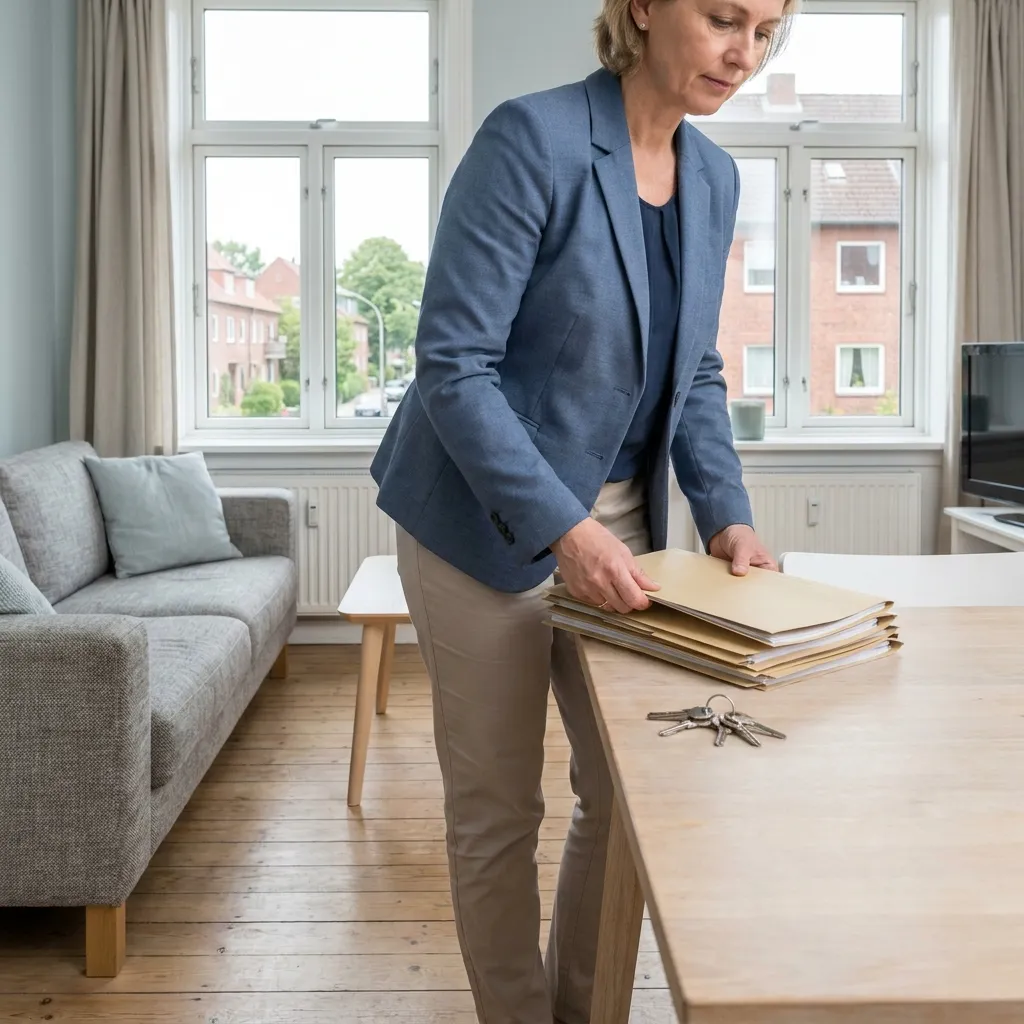
If you want to rent out an apartment in Schleswig-Holstein, the same questions often arise: How do I find the right rental price? What documents do I need? How do I screen interested parties fairly and properly? And how do I manage to rent out legally securely without getting lost in the paperwork?
Especially for private owners in the north, the topic is often very concrete. Perhaps you want to rent out your first condominium in Kiel. Perhaps you have taken over an inherited property in Lübeck or the district of Plön. Or you hold an investment property in Schleswig-Holstein and want to set up the leasing professionally without immediately building up a large administrative apparatus.
This is precisely where a clear process helps. Because renting out property in Schleswig-Holstein has regional specifics. This applies not only to location and rent levels, but also to legal conditions that you should know. Anyone who starts well prepared saves time, money, and hassle later.
In this guide, we walk through the entire process step by step: from preparing the apartment, determining the rental price, and creating the listing, to tenant screening, the lease agreement, and the handover. In addition, we cover typical mistakes, practical everyday examples, and a compact checklist for renting out an apartment. Important: This article does not replace legal advice. Always check the currently applicable legal situation or consult a legal professional if in doubt.
The rental market in Schleswig-Holstein: Renting out an apartment with regional knowledge
Anyone wishing to rent out an apartment should first understand the market. In Schleswig-Holstein, this market is not the same everywhere. In cities like Kiel, Lübeck, or Flensburg, demand is often higher than in smaller towns. At the same time, amenities, year of construction, location quality, and target groups differ significantly.
A good starting point is reliable market data. According to the Investitionsbank Schleswig-Holstein, the median asking rent for the re-letting of existing apartments statewide was 10.00 euros per square meter net rent excluding heating and utilities. For new construction apartments, 14.00 euros per square meter, net rent (excluding utilities) identifiedIB.SH). This shows quite clearly that there is a noticeable gap between existing buildings and new construction.
At the same time, the Northern Statistics Office reports an average net rent (excluding utilities) for all rental apartments in Schleswig-Holstein of 7.41 euros per square meter (Statistical Office North).
An average net rent (excluding utilities) of 7.41 euros per square meter was calculated for all rented apartments.
| Key figure | Value | Time period |
|---|---|---|
| Re-leasing of Existing Properties | 10.00 €/m² | 2024/2025 |
| Listed Rent for New Construction | 14.00 €/m² | 2024 |
| Average Net Rent (Excluding Utilities) for Existing Units | 7.41 €/m² | 2022 Census |
| Percentage of Rented Apartments | 50,3 % | 2022 Census |
For you as a landlord, this means: Don’t rely on gut feelings or individual online listings. Look at comparable apartments in your specific neighborhood. That’s the foundation if you want to rent out your property in Schleswig-Holstein in compliance with the law and avoid vacancies.
Preparing Your Apartment Properly: Renting Out Your Apartment and Making a Good Impression
Before you write a listing, the apartment must be ready to rent. This may sound obvious, but it’s often overlooked. Keeping the apartment in good condition saves you from having to answer follow-up questions, builds trust, and improves your chances of finding suitable tenants.
First, check the material and its appearance:
- Are the walls, floors, and doors clean?
- Do the heating, windows, light switches, and plumbing work?
- Is there any moisture, significant wear and tear, or a need for repairs?
- Is the apartment empty, clean, and easy to get around in?
Especially when renting out your first apartment, it makes sense to take a look at the property through the eyes of a prospective tenant. What stands out right away? Where do concerns arise? Even small improvements—such as a fresh coat of paint, clean grout, repaired outlets, or properly aligned doors—make a big difference.
Next come the documents. These usually include:
- Energy Performance Certificate
- Floor plan, if available
- Living Space Information
- Information on Utilities and Heating Costs
- Information regarding basement, parking space, fitted kitchen, or communal areas
- House rules, if these are to become part of the tenancy agreement
A small example: Daniela, 35, took over an inherited apartment in Neumünster. The location was solid, but the bathroom looked old and the paperwork was unsorted. After two minor repairs, fresh lighting, and a neat folder of documents, the offer immediately looked more professional. The result was not only more demand, but also better conversations with prospective buyers.
If you do not want to manage the process alone, a regional rental service like Rented correctly, in the true North help with preparation, documents, and procedure. Especially with single properties, this is often more relaxed than an improvised start.
Legal basis: What particularly matters in Schleswig-Holstein
When landlords talk about ‘legally secure renting’, they usually mean three things: an appropriate rent, a clean contract, and a documented handover. That is precisely where the greatest risks lie.
For Schleswig-Holstein, one point is particularly important: There is no rent control, but there is a lowered rent increase limit in certain municipalities. The Federal Institute for Research on Building, Urban Affairs and Spatial Development classifies Schleswig-Holstein precisely in this way (BBSRThis is important for new rentals because other federal states sometimes have stricter rules regarding the rent control cap. For ongoing tenancies, the limit on rent increases is decisive.
In 62 municipalities in Schleswig-Holstein, rent increases are capped at 15 percent over three years starting May 1, 2024.
In practice, this means: When re-letting, you should carefully check the local comparative rent and the market situation. For later rent increases for existing tenancies, it depends on whether your apartment is located in one of the affected municipalities. Different limits apply outside these areas.
Documentation is also important. Note down how you determined the rental price. Record the condition of the apartment before moving in. Store tenant application forms, proofs, and correspondence in compliance with data privacy regulations. If questions arise later, complete documents are often worth their weight in gold.
This post does not constitute binding legal advice. Always check the current legal situation, regional regulations, and the specific case.
Determining the rent price: Renting out an apartment with realistic calculation
Determining the rental price is one of the most sensitive issues when renting out property in Schleswig-Holstein. If you set the rent too high, you risk long marketing periods, many prospective tenants backing out, or attracting the wrong target group. If you set it too low, you are giving away yield and creating unnecessarily difficult starting conditions for later.
Therefore, proceed in four steps:
1. Evaluate location and property honestly
Is the apartment centrally located or rather on the outskirts? What is the connection like? Is there a balcony, parking space, fitted kitchen, or elevator? Is it in an old building, a modernized existing building, or a new construction?
2. Check competing quotes
Check out current listings in your city and the immediate surrounding area. Pay attention not only to the price, but to true comparability in terms of size, condition, and amenities.
3. Add local data
The IB.SH shows that the market in the country remains tight. LBS Immobilien Schleswig-Holstein also reports an average rent for the first quarter of 2025 of 9.81 euros per square meter and an increase of 6.39 percent compared to the previous year (LBS Immobilien Schleswig-Holstein).
4. Ability to justify the price
If a prospective tenant asks why your apartment costs 11.20 euros per square metre, you should have the answer ready: good location, modernised bathroom, balcony, parking space, new windows, well-maintained building, matching comparative offers.
A before-and-after scenario shows the difference: A landlord in Kiel set the rent based solely on an expensive online listing. The result was many inquiries, but hardly any serious viewings. After a correction based on actual comparable apartments and a clear justification, a suitable tenant was found more quickly. This is how apartment rentals work in practice.
Exposé and advertisement: Renting out an apartment and appealing to the right tenants
A good listing should not only generate attention. It should attract the right people and reduce mismatched inquiries. Exactly for this reason, an objective, honest exposé is often stronger than overly promotional text.
Pay attention to these components:
- precise title with location, size, and special feature
- clear details on living space, number of rooms, and floor
- net rent, utilities, and deposit
- Information on move-in date and amenities
- expressive, bright photos
- transparent information on what is expected, such as a non-smoking household or proof of creditworthiness, provided it is formulated fairly and within legal limits
Write concisely, but specifically. Instead of ‘nice apartment’, better: ‘well-maintained 2-room apartment with balcony and fitted kitchen in a quiet location’. Instead of ‘state-of-the-art’, prefer to name what was modernized.
Imagine your listing is like a first viewing on the screen. Prospective tenants want to see if the apartment fits their lifestyle. So show the kitchen, bathroom, living room, view, and if possible, details like the flooring or balcony. Blurry cell phone photos in poor lighting cost trust.
If you do not wish to advertise publicly, direct matching can also make sense. Richtig Vermietet, Im Echten Norden operates regionally and, according to the company, also assists with matching without public listings. This can be interesting if you want to rent out efficiently and are not looking for a flood of unsuitable inquiries.
Screening prospective tenants: fair, GDPR-compliant, and with a clear system
Choosing the tenant often determines whether a tenancy runs smoothly later on or becomes unnecessarily stressful. Nevertheless, the screening process should never be based on sympathy alone. You need a fair and transparent system.
Typical documents for the exam are:
- Tenant self-disclosure form
- Proof of income
- Proof of identity
- Schufa credit report if applicable
- Certificate from previous landlord or references, where applicable
Timing is important. Not every document needs to be requested before the viewing. Many landlords use a tiered process: first basic data, then the viewing, and then further proof if there is serious interest. That seems professional and respectful.
Only request data that is truly necessary for the rental process. This protects both you and the applicants. Explain transparently why you need which documents and how you handle them. Especially in tight markets, prospective tenants greatly appreciate a clear process.
A practical example: Daniela received 28 inquiries for her apartment in Kiel within a few days. Instead of deciding based on a first good impression, she used a simple checklist: income matching the rent, complete documents, calm communication, realistic move-in date, verifiable information. In the end, this left a couple of applicants who were a good fit for the apartment. The signing went smoothly and both sides were satisfied with the result.
If you want to hand off this part, a local rental service can save a lot of work with tenant screening, reference checks, and document filing.
The rental agreement: Renting out an apartment is better clear and neat than complicated
A lease agreement does not have to sound particularly long to be good. On the contrary: understandable regulations help both parties. Use only current and appropriate contract templates. Do not copy old templates from the internet if you are not sure whether they still comply with current law.
What you should look out for:
Describe the rental property precisely
Which rooms, basement areas, parking spaces, or common areas are included?
List rent and utility costs clearly
Clearly distinguish between net basic rent, advance payments, and potential additional services.
Regulate the security deposit clearly
How high is it? When is it due? How is it managed?
Include minor repairs, cosmetic repairs, and building regulations in a legally compliant manner only
Mistakes often arise right here. What used to be in many standard contract templates is not automatically valid. Check such clauses carefully or seek legal assistance.
Keep deadlines and formalities clear
Vague formulations invite disputes later.
If you want to rent out your property in a legally secure manner, this is one of the points where professional help can be particularly useful. Through a regional service like regional rental service for Schleswig-Holstein processes can be bundled, such as in document processing or partner support. This does not replace legal advice, but it can bring order and security to the process.
Handover, security deposit, and ongoing management: This is where the quality of the rental shows
Once the contract is signed, the part that many underestimate begins: the clean handover and the subsequent management. This is precisely where it is often decided whether a tenancy starts smoothly.
The handover always includes:
- Handover protocol
- Photos of the condition of the rooms
- Meter readings for electricity, water, and heating, as applicable
- Number of passed keys
- Documentation of visible defects
Take enough time for this. Go through room by room. Formulate objectively, not judgmentally. If something is damaged, write it down and take a picture of it. If everything is in order, record that as well.
The security deposit must be handled separately and correctly. Inform the tenant transparently about the process. Clear communication also helps during an ongoing tenancy. Respond promptly, document important issues in writing, and remain polite yet firm.
For landlords with small portfolios, this is often the most pleasant path: fixed processes instead of spontaneous case-by-case decisions. This reduces conflicts, simplifies later billing, and makes renting more predictable in the long term.
Common mistakes of private landlords in Schleswig-Holstein
Many problems do not arise from malicious intent, but from uncertainty or haste. These mistakes occur particularly often:
- The rental price is set without a market review.
- Documents are missing or incomplete.
- Properties are rented out too quickly to the most likeable applicants.
- Contract clauses are copied from old templates.
- The handover will be done orally only.
- Communication and records are not properly filed.
Looking at the overall market is also important. Schleswig-Holstein remains a relevant rental market. The share of rented apartments is 50.3 percent (Statistical Office NorthAt the same time, while in 2025 10,624 apartments approved, but the construction backlog was 29,853 apartments (Statistical Office North). This shows: Supply is not created immediately. For existing owners, this is an opportunity, but also a responsibility.
We see the reintroduction of the lowered rent increase cap, as agreed in the coalition agreement, as a regulation for the protection of tenants that can be implemented with a sense of proportion.
The message is clear: Anyone renting out property in Schleswig-Holstein should think economically, but take the rules seriously.
Compact checklist for your apartment rental
If you want to rent out your apartment, you can use this sequence as a guide:
- Inspect the apartment and fix minor defects.
- Have the energy certificate, floor plan, and cost data ready.
- Evaluate market and comparative offers in Schleswig-Holstein.
- Determine the rental price in a comprehensible manner.
- Create a property listing with good photos and clear details.
- Organize viewings in a structured way.
- Evaluate prospective tenants fairly and in compliance with data privacy regulations.
- Use the current rental agreement tailored to the specific case.
- Regulate the deposit, additional costs, and house rules clearly.
- Document handover report, photos, meter readings, and keys.
- Store documents securely and conduct communication in writing.
If you realize at some point that you lack time, experience, or confidence, that is not a disadvantage. It is often precisely the right moment to get support.
FAQ on renting in Schleswig-Holstein
What documents do I need to rent out an apartment?
At a minimum, an energy certificate, floor space details, information on utility costs, a current lease agreement, a handover protocol, and documents for determining the rental price are useful.
How do I find the right rental price?
Compare similar apartments in your location, check local market data, and use condition, amenities, and demand as a guide. Do not rely solely on a single online listing.
Is there a rent control in Schleswig-Holstein?
No. According to the classification by the BBSR, there is no rent control (Mietpreisbremse) in Schleswig-Holstein. Nevertheless, you should proceed in a market-appropriate and well-documented manner when re-letting.
What is important regarding rent increases for existing tenancies?
Since May 2024, a reduced rent increase limit of 15 percent over three years has applied in 62 municipalities. Always check whether your municipality is affected and which rules apply in your specific case.
How do I find suitable tenants?
With a clear listing, structured viewings, and a fair review of documents. The important thing is a system, not just a gut feeling.
When is professional support worthwhile?
Especially when you are renting out for the first time, taking over an inherited property, have little time, or want to rent out in a legally secure manner without having to organize every step alone.
Now rent out your apartment in a relaxed and well-prepared manner
Renting out an apartment in Schleswig-Holstein does not have to be a leap into the unknown. With good preparation, realistic rental price determination, thorough screening, and clear documentation, you create the foundation for a stable tenancy. Ultimately, that is the core of ‘legally secure renting’: not acting in a complicated manner, but systematically.
Here are the main points again briefly:
- Know your regional market.
- Prepare the apartment and documents completely.
- Set the rental price in a transparent and verifiable manner.
- Screen prospective tenants fairly and in compliance with data protection laws.
- Use a current and appropriate lease agreement.
- Document handover, deposit, and communication properly.
- Always check the currently applicable legal situation or seek professional advice.
Especially in the north, many owners appreciate a calm, clear, and personal process. If you want to rent out your apartment in Schleswig-Holstein in a relaxed and legally secure manner, clear processes and regional experience provide noticeable support. You can find more information and contact options at Richtig Vermietet, Im Echten Norden. This turns uncertainty into a structured process that works well for both landlords and tenants.